

By: Zagazola Makama
The Federal High Court in Abuja has warned defence lawyers against actions capable of delaying the trial of four suspected members of the proscribed Indigenous People of Biafra (IPOB), who are accused of kidnapping and killing a Department of State Services (DSS) operative, Ekpeyong Asuquo Owoh.
Justice Joyce Abdulmalik gave the warning on Wednesday while ruling on an application by the prosecution to conceal the identities of its witnesses and considering requests by defence counsel for an adjournment.
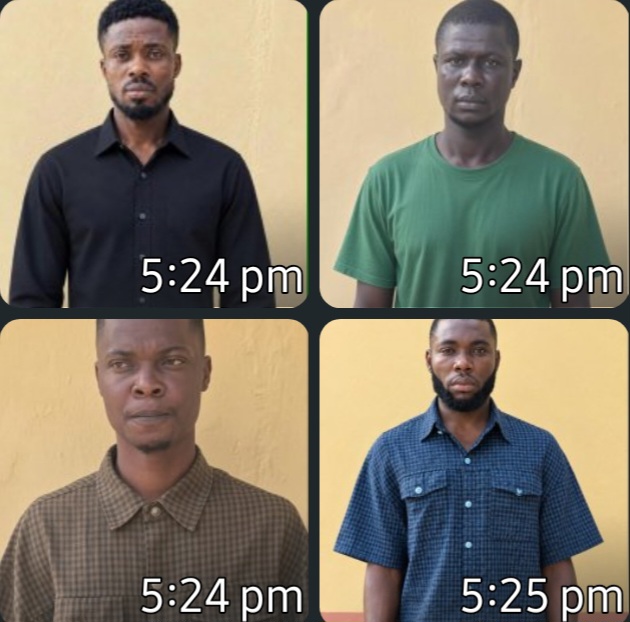
The defendants are Michael Okafor, also known as Onyechimeleze; Chinedu Chukwudozie, alias Kante; Chibunna Olisa; and Chigozie Olisa, also known as Ability.
They were arraigned on Sept. 28 on a six-count charge bordering on terrorism, kidnapping and other alleged offences. They pleaded not guilty to the charges.
The prosecution alleged that the defendants conspired to commit acts of terrorism and participated in the abduction of Owoh while he was travelling from Port Harcourt, Rivers State, to Awka, Anambra State.
They were further accused of taking the operative hostage and killing him.
The defendants were also alleged to be members of IPOB and its armed wing, the Eastern Security Network (ESN), and to have been involved in activities linked to terrorism.
The prosecution further accused them of unlawful possession of firearms, including an AK-47 rifle and a pump-action gun, in connection with the alleged offences.
When the case came up on Wednesday, prosecution counsel, Munirat Oladunjoye, informed the court that the matter was scheduled for trial following the defendants’ denial of the allegations.
Oladunjoye applied for permission to conceal the identities of prosecution witnesses under Section 232(3)(b) of the Administration of Criminal Justice Act (ACJA), 2015.
She asked the court to allow the witnesses to testify under protected identities, arguing that the nature of the terrorism case warranted the measure.
However, Kelvin Ekwe, counsel to the first and second defendants, opposed the application, arguing that the prosecution had not demonstrated that revealing the witnesses’ identities would prejudice its case.
Ekwe also submitted that the application should be formally filed to enable the defence to respond appropriately and avoid being taken by surprise.
Justice Abdulmalik asked the lawyer to identify the legal provision requiring the prosecution to file a formal application before seeking such an order.
Ekwe relied on Section 36 of the 1999 Constitution, which guarantees the right to a fair hearing.
In her ruling, the judge agreed with the prosecution that exposing the identities of witnesses in a terrorism-related trial could undermine the interests of justice.
She consequently directed that the trial proceed with the witness identified by the code name “AB”.
The judge also warned that anyone who violated Section 232(5) of the ACJA would be liable to a one-year jail term.
The proceedings were subsequently disrupted by requests from the defence for an adjournment.
Geoffrey Uwadiegwu, counsel to the third and fourth defendants, told the court that he was appearing in the matter for the first time and needed additional time to study the case file.
Ekwe also informed the court that the prosecution had only recently served him with video evidence, insisting that he was not ready to proceed with the trial.
Oladunjoye responded that although the video evidence had just been served, it would not be used during the day’s proceedings.
She urged the court to allow the trial to continue, adding that Ekwe’s absence on Oct. 6 had contributed to an earlier adjournment.
The two defence lawyers subsequently stood up simultaneously to address the court on the need for an adjournment, prompting Justice Abdulmalik to caution them against unruly conduct.
“I run my court in line with international best practice, and that is why people say I am strict,” the judge said.
She added that proceedings in her courtroom must comply with the highest standards of courtroom discipline.
Justice Abdulmalik explained that she had a heavy workload, including several pre-election cases and at least nine judgments to deliver before Nov. 9.
She said she would ordinarily have been reluctant to list the matter for hearing because of the competing demands on the court’s docket.
However, she described the terrorism case as crucial and said it should be determined expeditiously.
After listening to the parties, the judge granted a short adjournment but warned the defence against any further conduct capable of delaying the proceedings.
The case was adjourned until Oct. 28, 2026, at the instance of the defence lawyers, for continuation of trial.