

By Rukaiya Musa Hyera, Maiduguri
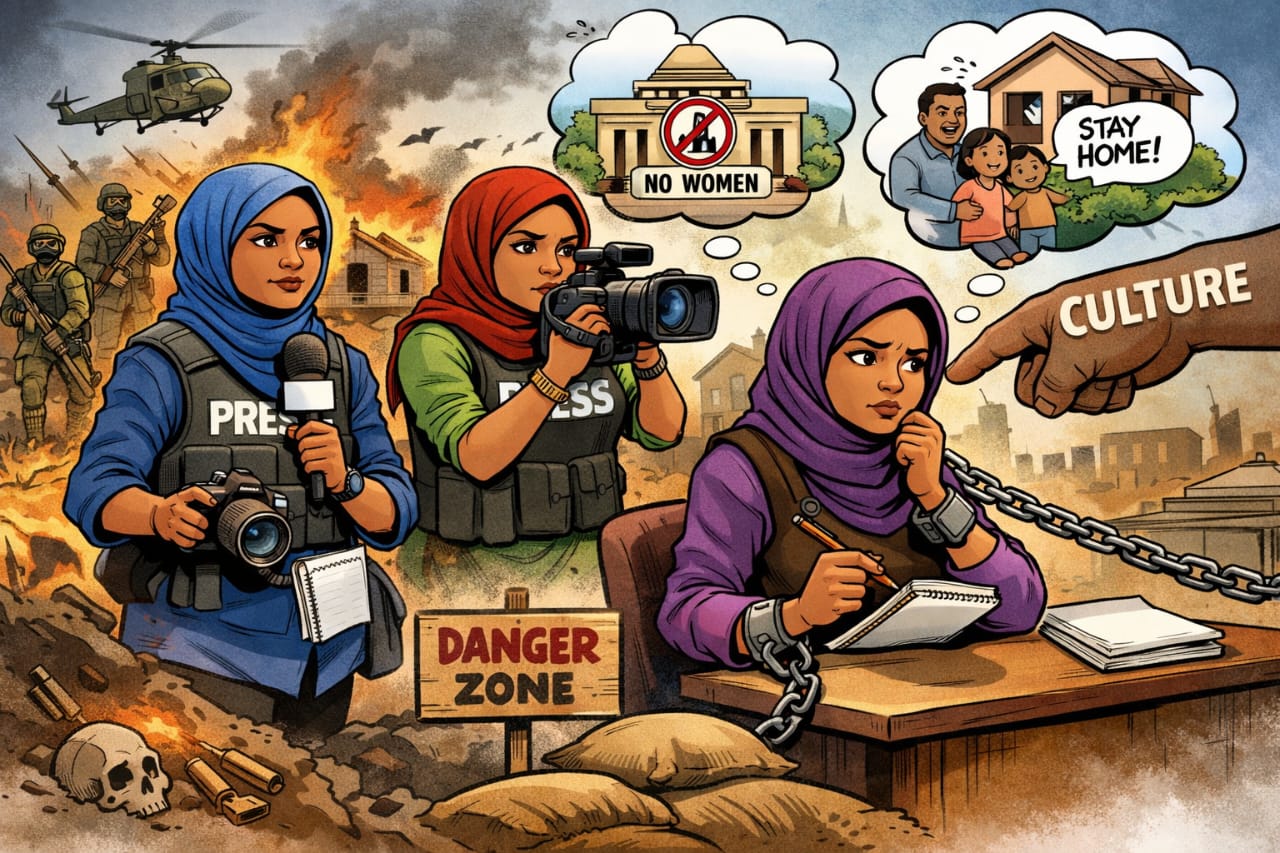
In the heart of northeastern Nigeria, where conflict and insecurity shape daily life, female journalists are quietly rewriting the rules of their profession. From the frontlines of insurgency-affected communities to the crowded newsrooms of Maiduguri, women are risking their safety, challenging cultural norms, and navigating systemic barriers to tell stories that often go unheard.
Their work is not just reporting—it is an act of courage, a testament to resilience, and a declaration that even in the most difficult environments, their voices matter.
A Calling Beyond Fear
For Pauline Kuje Vana, journalism is more than a profession it is a calling shaped by courage, persistence, and a deep commitment to telling stories that matter.
A journalist with the Nigerian Television Authority (NTA) Maiduguri, Pauline began her career in 2003 at the Nasarawa Broadcasting Service (NBS) Lafia, Nasarawa State. Her journey later took her to Borno State, where she served with the Borno Radio Television Authority during her service year before securing a position with the NTA. Over the years, she has built her career around public interest reporting—covering governance, politics, humanitarian crises, and post-conflict recovery. Her work amplifies the voices of vulnerable and marginalized groups, particularly women and children affected by conflict in northeastern Nigeria.
Her passion for journalism dates back to her secondary school days, when she joined the press club under the mentorship of her English teacher. But it was her exposure to the harsh realities of conflict in Borno that gave her work deeper meaning.
“Coming here, I saw things I had never seen before—deep injustice and human suffering,” she recalled. “I knew those stories could not go untold.”
Breaking Barriers in a Male-Dominated Field
Beyond the dangers of conflict reporting, Pauline has had to navigate another layer of challenge being a woman in a profession where subtle inequalities persist. Female journalists often face unspoken limitations in the newsroom. While institutional efforts exist to promote gender fairness, women are frequently shielded from high-risk or demanding assignments under the guise of protection. Editors and supervisors tend to limit their exposure to certain beats, often underestimating their capabilities.
High-profile assignments such as the Government House, the House of Assembly, and other sensitive beats are often considered unsuitable for women.
Determined to prove her capability, Pauline took on assignments she was advised to avoid, including one of the most dangerous reporting environments in Nigeria—the Sambisa Forest at the height of the insurgency around 2013–2014.
“They told me I couldn’t do it, that I shouldn’t go,” she said. “But I wanted to see for myself, to witness what others were witnessing.”
Against all odds, she went, reported, and returned safely. For her, the experience was more than just another assignment, it was a statement.
“What a man can do, a woman can do even better,” she said.
Facing Real Threats and Personal Sacrifices
Pauline’s journey has not been without risks. While covering insurgency-related developments, she once received a threatening call from an unknown individual who claimed to know personal details about her life, including her family and residence.
“I was confused and scared. He said he knew my husband and where I lived,” she recalled. With the support of her editor, she navigated the threat, though the psychological impact lingered.
Sexual harassment has also been part of her experience. Pauline described incidents where individuals attempted inappropriate physical contact, forcing her to constantly balance cultural expectations with the demands of her profession.
The dangers became even more real during her coverage of the Maiduguri Monday Market fire incident on February 26, 2023. While reporting from the scene, she and her cameraman were attacked and beaten severely. They were eventually rescued by military personnel, but the experience left a lasting mark.
“It’s something I will never forget,” she said. “From assignment to hospital bed, I was there trying to let the world know what was happening.”
Despite the trauma, Pauline continued pushing forward, refusing to let intimidation, harassment, or gender biases silence her voice.
But beyond the visible dangers of the job lies a quieter, deeply personal struggle—the challenge of balancing her professional mission with family life.
“As a wife and a mother of two, balancing my career and activism is a demanding responsibility,” she said. “It is something I navigate every day to keep life stable and smooth for my family, while also meeting expectations at work and giving a voice to vulnerable people who depend on my reporting.”
Her story is not just one of survival in a conflict zone, but of resilience in the face of layered pressures professional, cultural, and personal.
Challenges Across the Field
For Aisha Talba Ballama, Assistant Secretary of the Nigeria Association of Women Journalists and a journalist with the Borno Radio Television Authority, working in Maiduguri presents daily challenges that go far beyond the newsroom.
“As a journalist, I encounter several challenges in my line of work. Key among them is limited access to information, especially in conflict zones like Maiduguri,” she explained.
Safety remains a constant concern particularly for women. “There are safety risks while covering sensitive stories. Women are the most vulnerable, so we face more challenges in the field,” she said.
Verification of information is another hurdle. “At times, it is difficult to get verified information. As a woman, it can even be harder because we are sometimes seen as weaker or neglected.”
Like many female journalists, she also struggles to balance professional demands with personal responsibilities. “Time constraints and tight deadlines affect my work because I have to balance being a mother, a wife, and a journalist. It becomes difficult sometimes.”
Institutional Support and Structural Barriers
Chiroma Ali Ibrahim, Secretary of the Nigerian Union of Journalists (NUJ) Borno State Chapter and Head of News and Current Affairs at Peace FM Maiduguri, explains that female journalists face unique and severe challenges in the state, which remains the epicenter of the Boko Haram insurgency.
“One of the major challenges is access to hard-to-reach areas, especially rural communities outside the state capital,” he said. “These areas are critical for reporting, but many female journalists find it difficult to travel there due to security risks and logistical constraints.”
He added that the lack of basic facilities, particularly water, sanitation, and hygiene (WASH) amenities, further discourages female journalists from rural assignments. Accommodation is also a significant barrier: while male journalists can sometimes manage by sleeping in open spaces, female journalists must consider safety and privacy.
Cultural and religious norms in northeastern Nigeria also restrict women’s working hours. “In Borno State, women are expected to be home by 4 or 5 p.m. This makes it difficult for female journalists to work late hours,” Ibrahim explained. As a result, many media organisations assign female journalists to morning and afternoon shifts, while male journalists handle evening duties.
Despite these challenges, the NUJ has been proactive in advocating gender inclusion. The union encourages media houses to create gender desks, led by female journalists, and supports capacity-building programs, including international training opportunities.
Gender, Culture, and the Fight for Recognition
Dr. Musa Usman Konduga provides a broader perspective on the systemic issues affecting female journalists in the region. He notes that their numbers in the northeast remain significantly lower compared to cities like Abuja, Kano, Kaduna, and Lagos.
According to him, female journalists often work with caution due to insecurity, while men dominate field reporting, especially in hard-to-reach areas.
He attributes many of the challenges to cultural and social factors, including patriarchal traditions and marital expectations that limit women’s participation in journalism. Married female journalists, in particular, face additional pressures, as some husbands are uncomfortable with their wives working in mixed environments or traveling for assignments.
“These are cultural issues,” he explained. “Because of the perception that women are too vulnerable, they are often excluded from challenging assignments, regardless of their capabilities.”
These limitations, he said, affect the confidence and professional growth of female journalists. However, he emphasized that women bring unique strengths to journalism, particularly in accessing sensitive information and building trust with vulnerable groups.
“Female journalists can reach people that men cannot,” he noted. “They are trusted more, especially by women and children, who are often the most affected by conflict.”
He called for greater organizational and societal support, urging media institutions to involve women in decision-making processes, eliminate stereotypes, and create more inclusive work environments.
“With better education, gender equity, and societal support, the future is promising,” he added. “Women have a lot to contribute to journalism and society.”
A Resilient Force
Together, these voices paint a powerful picture of resilience, courage, and determination. Female journalists in Borno continue to operate in one of the most challenging environments in Nigeria, navigating insecurity, cultural limitations, and professional inequalities.
Yet, they persist not just as reporters, but as storytellers, advocates, and voices for the voiceless. Their work goes beyond headlines; it shapes narratives, influences public understanding, and gives visibility to those often forgotten.
In a region where conflict has silenced many, these women refuse to be silent. Instead, they stand at the Frontlines documenting, questioning, and telling the stories that must be told.