

By Fatima Mukhtar
The corridors of many Federal Unity Schools across the country fell silent on Friday as the Federal Government ordered their immediate closure, a move triggered by escalating insecurity and renewed attacks on educational institutions.
For parents like Mrs. Hauwa Musa in Kaduna, the announcement felt like déjà vu. “Every time we think things are getting better, we are reminded that our children are not safe,” she said while hastily arranging transport to pick up her daughter from school.
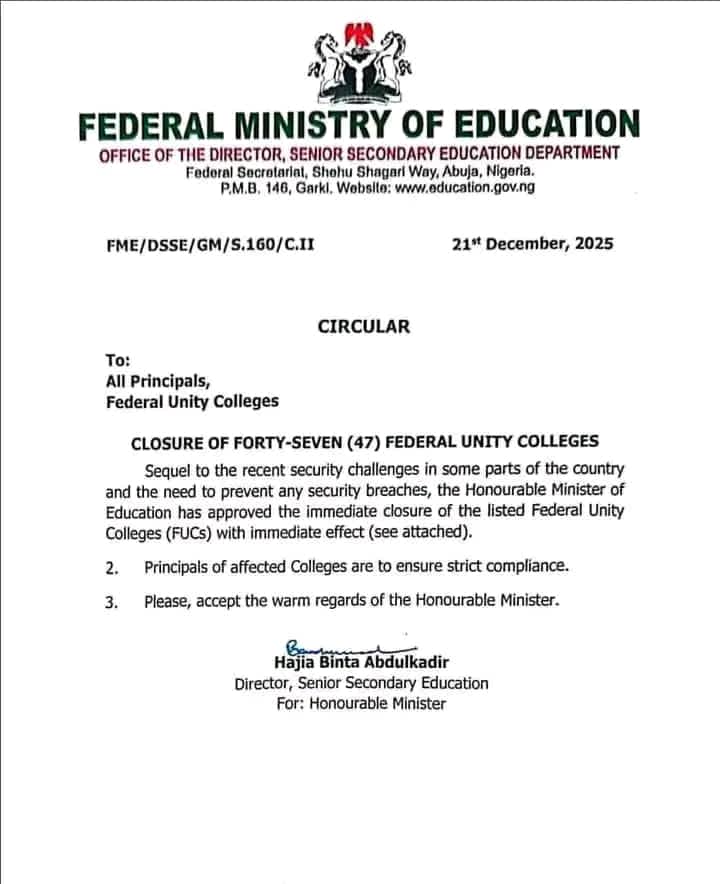
The directive came through a circular issued by the Ministry of Education, signed by the Director of Senior Secondary Education, Binta Abdulkadir, on behalf of the Minister. According to the ministry, shutting down 47 Unity Colleges—mostly in high-risk northern states—was unavoidable after fresh waves of school abductions and violent attacks.
Principals have been instructed to comply immediately and ensure students are safely notified and evacuated where necessary. The government reassured families that the closure is temporary, describing it as a “precautionary measure” until security agencies stabilize the affected areas.
But parents remain anxious. In Katsina, Plateau, and Kwara—states that recently closed some of their own public schools—many families worry about interrupted academic calendars, while others simply pray their children return home safely.
Despite the disruptions, officials insist the decision puts student safety first. “Schools can be reopened,” one ministry source noted, “but lives cannot be replaced.”
As uncertainty hangs over the education sector, families hope the silence in these classrooms won’t last longer than necessary—and that when students return, they will return to a safer Nigeria.