

By:Abdullahi Inuwa
The launch of the inaugural U.S.–Nigeria Working Group in Abuja has signalled a decisive shift in bilateral security cooperation, marking a move away from ad-hoc engagements toward a standing framework built on coordination, accountability and joint action against terrorism.
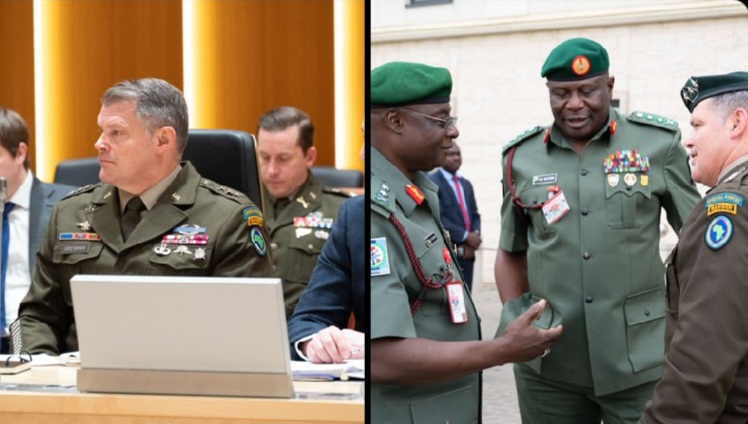
The presence of Lt. Gen. John Brennan at the launch, alongside senior Nigerian security and political leaders, underscored the strategic weight Washington now attaches to Nigeria’s role in regional stability. It was a clear message that Abuja is no longer viewed merely as a frontline state battling insecurity, but as a partner central to shaping counterterrorism outcomes in West Africa.
At the heart of the new framework is structure. For years, cooperation between both countries has been driven by goodwill, periodic consultations and operational support. The Working Group seeks to formalise that relationship—creating predictable channels for intelligence sharing, clearer lines of responsibility and measurable benchmarks for progress.
For Nigeria, the timing is significant. After prolonged campaigns against insurgents in the North-East and criminal networks across the North-West and North-Central, policymakers have increasingly acknowledged that fragmented efforts leave exploitable gaps. The new platform is designed to synchronise military, intelligence and civilian protection strategies, ensuring that gains in one area are not lost in another.
A defining feature of the Working Group is its emphasis on protecting vulnerable communities. This reflects a growing consensus that counterterrorism cannot rely solely on firepower. Civilian protection, early warning systems and community resilience are now recognised as strategic tools that weaken extremist recruitment and restore public confidence in the state.
From the U.S. perspective, the initiative is both strategic and preventive. Instability in Nigeria—the most populous country in Africa—has direct implications for the Sahel and the Gulf of Guinea. By anchoring cooperation in an accountable framework, Washington is betting that sustained engagement will be more effective than episodic interventions.
For Abuja, the Working Group offers more than support; it provides influence. Nigeria gains a seat at the table in setting priorities, shaping joint responses and ensuring that international assistance aligns with local realities rather than external templates.
Still, expectations are cautious. Security frameworks succeed not on paper but in practice. Their effectiveness will depend on political will, inter-agency discipline and the ability to translate shared plans into action that communities can feel.
Yet the symbolism of the Abuja launch is unmistakable. It tells extremist groups and criminal networks that Nigeria and the United States are closing ranks—and doing so with a clearer strategy and firmer resolve.
In a region where insecurity feeds on weak coordination and slow responses, the U.S.–Nigeria Working Group represents a calculated reset. Whether it becomes a turning point or another diplomatic footnote will depend on what follows—but for now, the message is clear: the partnership is tightening, and the stakes are high.